Skip to content
Banner Icon

Palantir and Zeta Global announce strategic partnership. Learn more

Athena by Zeta

Athena by Zeta™

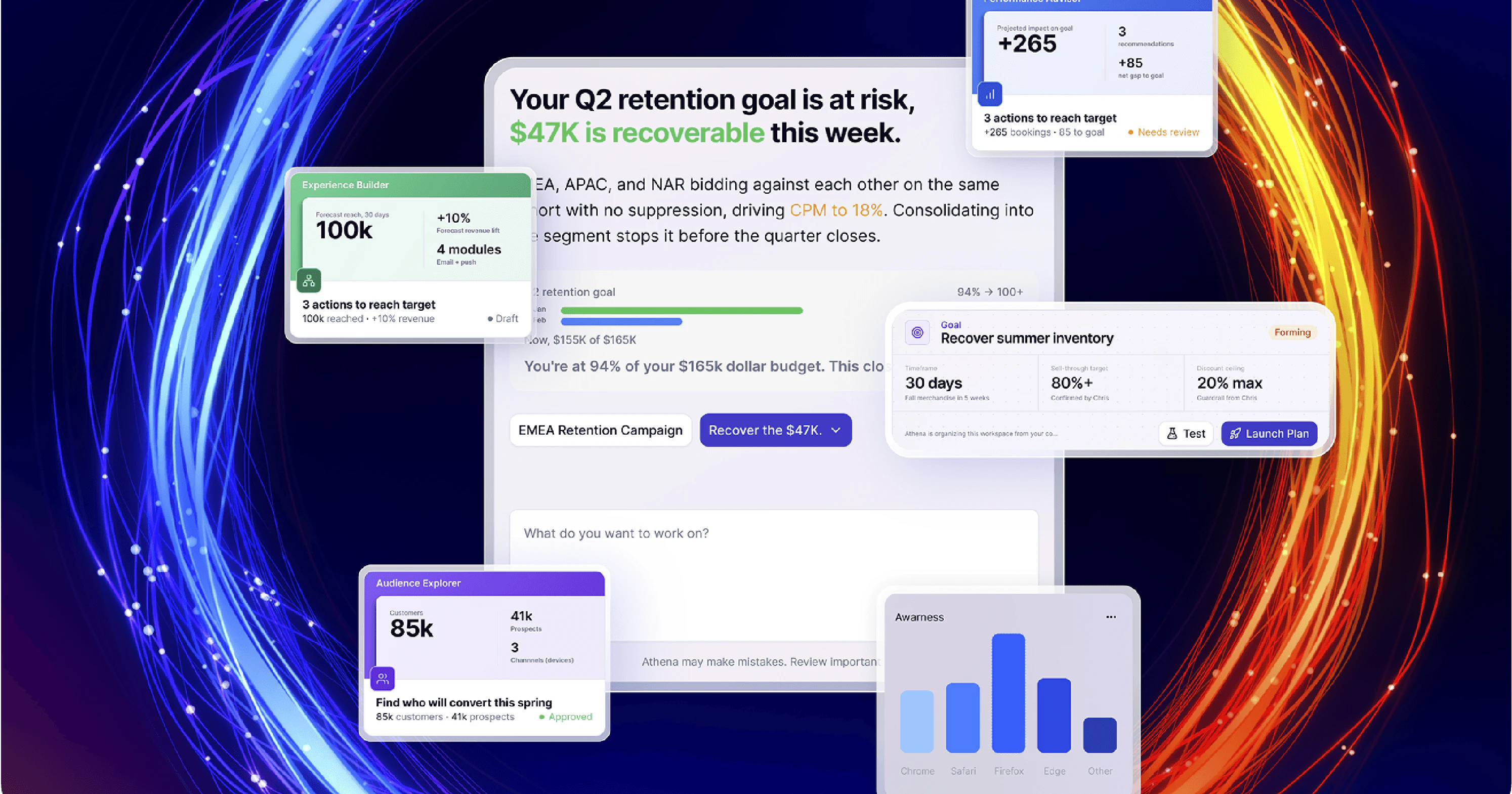
Athena by Zeta is the beginning of a new era in marketing. The first superintelligent agent built for marketers—powered by proprietary data, contextual intelligence, and seamless integration with the Zeta Marketing Platform.  

Athena by Zeta
  • Athena by Zeta Overview

  • Athena for Brands

  • Athena for Agencies

Zeta Data & AI
  • Zeta Data

  • Zeta Identity

  • AI Agents

  • AI Orchestration

Athena Navigation Thumbnail
Meet Athena by Zeta
This isn’t just another tool—Athena by Zeta is intelligence that doesn’t just inform, it acts.
ZMP Login

Platform & Products

Zeta Marketing Platform

Unified data and AI in one platform, across all your marketing channels. Get predictable growth, real results, and clear ROI.

Zeta Marketing Platform
  • ZMP Overview

    AI-powered customer experience

  • Omnichannel Activation

    Drive acquisition and campaign execution across paid channels

  • Customer Data Platform

    Understand and recognize customer identity

  • Analytics & Attribution

    See results as they happen

  • Customer Messaging

    Orchestrate real-time, personalized communication across owned channels

  • HIRO for Publishers

    Turn anonymous traffic into revenue

  • Customer Loyalty

    Power loyalty and build lifetime customer engagement

Channels
  • CTV

  • Programmatic Display

  • Email Advertising

  • Mobile Messaging

  • Email Messaging

ZMP Login

Use Cases

Use Cases

Learn how leading brands are achieving the impossible with Zeta. Explore the solutions we offer by industry and by business objective and discover the impact you can expect when working with an industry leader. 

By Industry
  • Retail

  • Travel & Hospitality

  • Financial Services

  • Publishers

  • Media Agencies

  • Advocacy

  • QSR

  • Additional Industries

By Business Goal
  • Acquisition

  • Customer Growth

  • Retention

  • Loyalty

Use Cases Navigation Thumbnail
Zeta Attribution
Every customer is a real person on a real journey. Only Zeta can tell you the whole story.
ZMP Login
Partners

Resources

Resources

Use these tools and insights to better understand the value of Zeta and learn how you can improve your marketing outcomes and experiences.

  • Insights

    Resource Center

    Original research, intelligence, and expert advice only Zeta can provide.

  • Case Study Icon

    Customer Success Stories

    Discover how leading brands turn strategy into impact with Zeta.

  • Zeta Economic Index

    Zeta Economic Index

    Consumer attitudes and activities revealed by our proprietary Data Cloud.

  • Zeta Results

    Zeta Results Calculator

    Learn how Zeta can lower your total cost of ownership over time.

  • Responsible Data Practices

    Responsible Data Practices

    Resource to help navigate responsible data and privacy management.

image of two people looking cozy in front of a computer - featured image for unify adtech and martech landing page
EMARKETER: Unifying Martech and Ad Tech Gives Marketers an Edge
New Research from EMARKETER and Zeta revealed
ZMP Login

About

About

Zeta Global is the AI-powered marketing cloud that leverages proprietary AI and trillions of consumer signals to make it easier to acquire, grow, and retain customers more efficiently.

  • Our Story

  • Leadership

  • Locations

  • Contact Us

  • Life at Zeta

  • Our Virtues

  • Job Openings

  • Investors

About Us
Our People Are the Pulse of Zeta
Join our culture committed to building innovators and future leaders.
ZMP Login
Press & News
ZMP Login
ZMP Login
magnifying glass
Home » Resource Center » France’s CNIL Recommendations Pu...

France’s CNIL Rules Push Marketers to Use Opens Even Less

By Chad S. White GVP, CRM Strategy
Published on June 22, 2026

New privacy rules in Europe are placing fresh limits on the use of tracking pixel data, which has already seen its usefulness decline dramatically in the wake of Apple’s Mail Privacy Protection. In the latest move, the French data protection authority CNIL has published its final recommendations on the use of email tracking pixels, which extends the consent requirements of the ePrivacy Directive of 2003 to also cover pixels in emails.

Going into effect in mid-July 2026, the rules require senders to get explicit permission from subscribers in France for some tracking pixel use cases. The same rules will apply to subscribers in Italy in October.

In general, it’s not the collection of open data that runs afoul of these rules, but rather the use of tracking pixel-derived information for particular uses without permission from the subscriber.

Track Pixel Use Cases that Require Permission

Brands need to collect separate and explicit permission to use tracking pixel data to:

  • Optimize email performance. This includes using open times for send time optimization, using device information to optimize email content, and using open activity to make channel-selection decisions when a customer is opted into multiple channels.
  • Augment customer profiles. This includes using open behavior as a signal of interest in the content of the email, such as using opens to trigger the next email in a series, sending segmented campaigns to openers or non-openers of a previous campaign, or using the opening of an email to change a customer’s interests in their profile.
  • Detect fraud against the sender. This includes using open data to detect ad fraud and to detect subscribers using automated means to submit a massive number of entries to a competition, for instance.

Track Pixel Use Cases that Don’t Require Permission

CNIL also exempts a number of tracking pixel uses. For example, this data can be used to:

  • Calculate aggregated open rates. Open rate tracking is permitted without permission only when the personal data has been previously anonymized.
  • Manage deliverability. CNIL recognizes that opens have a long history of being central to managing engagement rates and inactivity for the strict purpose of managing a sender’s deliverability, such as suppressing inactive subscribers or adjusting frequency for disengaged subscribers. For this use, senders can store only the date of the last open and cannot store open times or a history of open behaviors.
  • Authenticate user identity. For instance, opens can be used to confirm that an email containing a code used in the authentication process is indeed open on a terminal known to belong to the intended user.
  • Prove legal compliance. Keeping track of open is permitted to demonstrate legal compliance, such as when a brand needs confirmation that a customer received and read a legally required notification.
  • Determine contact method. Evaluate and adapt the communication channel to choose alternative contact methods, where appropriate.

For the sake of transparency, CNIL advises senders to update their privacy policies to include information about their uses of tracking pixels that do not require consent.

Securing Tracking Pixel Consent

Ideally at the point of email opt in, subscribers in France must separately consent to each desired purpose for pixel tracking via a positive action. For instance, if a sender wants to use pixel tracking to optimize email performance and detect fraud against the sender, they will need to have a brief and transparent description of both of those uses with an unchecked checkbox for opt in for each. Just like proof of email consent must be captured and retained, proof of tracking pixel consent must be similarly saved.

Brands will also need to provide an easy way for subscribers to withdraw permission for those uses, should they change their mind in the future. They should do this by linking a tracking link in the footer of each email that directs them to a webpage that allows them to withdraw their consent without any additional action. In particular, it shouldn’t require the subscriber to re-enter their email address.

For existing subscribers who signed up prior to April 14 2026 brands must notify them of their tracking pixel use before July 14 and provide them with the ability to opt out of the use of email pixels. After July 14, for any subscriber who has not been notified and given an opportunity to opt out, brands will have to collect their tracking pixel consent on an opt-in basis in order to collect and use this data.

For existing subscribers who signed up between April 14 2026 and when a brand’s new opt-in process for pixel consent goes live, brands must collect their tracking pixel consent on an opt-in basis as though they were a new subscriber.

Question Your Use of Tracking Pixels

This new regulation by France’s CNIL should prompt affected brands to audit their email marketing programs to understand how they’re using tracking pixel information. For any use that requires consent, brands should determine how vital that use case truly is.

That’s because it’s likely that the majority of people who subscribe won’t opt in for pixel tracking. In fact, it could be that the vast majority do not. It’s also likely that asking for opt-ins for more than one use case will decrease tracking pixel opt-ins even more. On top of that, asking for consent for even one tracking pixel use case may also depress email opt-ins by an amount that nullifies any benefits of securing those tracking pixel opt-ins.

Here are some issues to consider:

Mail Privacy Protection (MPP)

Especially if your brand has a high percentage of subscribers who receive your email campaigns via Mail Privacy Protection-enabled Apple Mail accounts, you may not be getting a lot of performance value out of open data. That said, because Apple’s auto opens are an unequivocal signal of inbox placement, the disappearance of auto opens means your emails to a subscriber are now landing in their junk folder or being blocked.

Open and non-open subscriber targeting

While it was fairly common to send a subscriber a follow-up campaign based on whether or not they opened the previous campaign, that practice suffered a major blow by MPP. Today, most B2C brands simply don’t have reliable open signals for enough of their subscribers for this tactic to be effective.

Intent signals

When it comes to augmenting a customer’s profile of interests, opens are a weak signal, even if your subject lines are highly descriptive. Email clicks, website and app activity, call center engagement, and conversions are much stronger signals that a customer or prospect is interested in a product, product category, or subject matter.

Send-time optimization

For brands sending no more than once a day, send-time optimization is still quite effective, even with the loss of many open signals in the wake of MPP. That’s in part due to most send-time optimization algorithms now incorporating the timing of higher-intent email clicks. However, relying only on email clicks would further dampen the effectiveness of send-time optimization.

Stronger profiling and performance data

While marketers never want to see their visibility into campaign engagement narrowed, the truth is that CNIL is further limiting open data that’s become of marginal use since MPP—with the key exception of use for deliverability and inactivity management, which CNIL wisely recognizes. Instead, campaign performance measurement and engagement signals have been migrating toward the bottom of the funnel and across channels at the customer level.

Email clicks, landing page activity, and conversions have always been much stronger first-party data signals for most brands. And as brands have embraced omnichannel orchestration and aggregated their customer data in customer data platforms, they’ve been able to drive personalization and activation in the email channel based on an email subscriber’s activities in other channels much more easily, as well as focus more on topline customer-centric metrics, like lifetime value.

When it comes to customer profiling, that cross-channel activity is a great way to gain visibility into all of your customer’s interactions with your brand and therefore their interests. And if you want a fuller understanding of your customers as consumers, data enrichment is an effective approach.

Of course, zero-party data collection is also a highly effective way to better understand your customers. Preference centers will become more important in the wake of these rule changes, as will all progressive profiling efforts, such as those enabled by Zeta Grow. Both long-term preferences (e.g., sports interests, favorite team) that are relevant for a few years and short-term preferences (e.g., vacation destination interests) that are relevant for only a few months are powerful tools for creating more relevant customer experiences.

While most marketers will think France’s clampdown on permission-based emails is unwarranted, it’s also true that marketers have been moving steadily away from opens as an intent and performance signal for years. CNIL’s ruling, which is likely to be adopted by other EU countries in the not-too-distant future, just accelerates that trend toward omnichannel engagement and customer-centric performance metrics.

Table of Contents
  • Track Pixel Use Cases that Require Permission
  • Track Pixel Use Cases that Don’t Require Permission
  • Securing Tracking Pixel Consent
  • Question Your Use of Tracking Pixels
  • Stronger profiling and performance data
Share Article
or copy this link
https://zetaglobal.com/resource-center/france-cnil-email-tracking-pixels/
You may also like
blue graphic with email icon - used to promote the Q1 2026 Forrester EMSP Wave
Reports
The Forrester Wave™: Email Marketing Service Providers, Q1 2026
Forrester has named Zeta a Leader among email service providers in the Q1 2026 EMSP Wave. Learn more.
Read More
person with a dog to promote the Gmail Manage subscriptions feature article
Articles
How Marketers Should Adapt to Gmail’s ‘Manage Subscriptions’
Gmail’s Manage Subscriptions feature is reshaping email marketing—learn its impact and how marketers should adapt to maintain deliverability and engagement.
Read More
two people with a laptop- featured image for email deliverability article
Articles
The Seventh Age of Email Deliverability
Discover how AI-driven inbox features from Gmail, Yahoo, and Apple are reshaping email deliverability—and what strategies marketers must adopt to stay ahead.
Read More

Want to see Zeta in action?

The Zeta Marketing Platform empowers enterprise-level brands to offer highly tailored experiences driven by AI. From data management, to personalization, to omnichannel activation, the ZMP does it all.
 
Learn more

Share this article via:

  • Facebook
  • Twitter
  • Linkedin
  • Viber
    (requires app)
  • E-mail
    (requires app)

or copy this link

Stay In The Know

Get fresh marketing insights delivered right to your inbox.

Thank you for joining our newsletter!

  • linkedin
  • facebook
  • twitter
  • instagram
Athena by Zeta
Athena by Zeta
Athena for Agencies
Athena for Brands
Zeta Data & AI
Zeta Data
Zeta Identity
AI Agents
AI Orchestration
Platform
ZMP Overview
Customer Data Platform
Customer Messaging
Omnichannel Activation
Analytics & Attribution
HIRO for Publishers
Products
CTV
Programmatic Display
Email Advertising
Mobile Messaging
Email Messaging
By Industry
Retail
Travel & Hospitality
Financial Services
Publishers
Media Agencies
Advocacy
Additional Industries
By Goal
Acquisition
Customer Growth
Retention
About
Our Story
Leadership
Locations
Partners Resource Center Press & News Case Studies Life at Zeta Investor Relations Trust Center
  • English
    • Français
    • Español
    • English (United Kingdom)
  • Privacy Policy
  • Privacy Choices
  • Acceptable Use Policy
  • UnsubCentral®
  • Cookie Settings
  • English
    • Français
    • Español
    • English (United Kingdom)
© 2026 Zeta Global Corp.

Step 1 of 3

Request demo

Thanks for your interest in Zeta. To see a demo please complete the form.

How would you describe your role?

What would you like to explore?

You're on the path

Your demo request is confirmed. An expert will contact you within 24 hours to showcase solutions built for your role.